Lake Tanganyika is one of the most significant freshwater lakes in the world. It holds records for being Africa’s deepest lake and the second-oldest and second-deepest lake globally. This article provides a clear overview of its location, physical characteristics, ecological value, and role in supporting human life and scientific research.
The Geographic Position and Size of Lake Tanganyika.
\

Lake Tanganyika is located in East-Central Africa and spans four countries: Burundi, the Democratic Republic of the Congo (DRC), Tanzania, and Zambia. It lies within the Albertine Rift, which is the western branch of the East African Rift system. The lake stretches 673 kilometers from north to south and is about 72 kilometers wide at its broadest point. It covers a surface area of approximately 32,900 square kilometers.
Tanzania holds the largest portion of the lake, covering approximately 46% of its total surface area, followed by the DRC with about 40%. Burundi and Zambia share the remaining portion. The lake’s waters flow out through the Lukuga River, which connects to the Congo River system and eventually drains into the Atlantic Ocean.
Geological Formation and Age.
Lake Tanganyika is estimated to be between 9 and 12 million years old, making it one of the oldest lakes on Earth. It was formed by tectonic activity along the East African Rift system. The shifting of the Earth’s crust created a deep basin, which eventually filled with water over millions of years.
it was discovered by England Explorers.
Lake Tanganyika was discovered by European explorers in the 19th century. Two English explorers, Richard Burton and John Hanning Speke, were among the first Europeans to reach the lake. Their expedition brought global attention to this African lake. During their exploration, they studied the Ruzizi River in the north, initially believing it to be the source of the Nile. However, they later realized that the river actually flows into Lake Tanganyika, not out of it.
Ecological and Biological Diversity.
Lake Tanganyika is known for its rich biodiversity. Scientists have recorded over 1,500 species in the lake, with about 600 species found nowhere else in the world. The lake supports a wide variety of aquatic life, including fish, mollusks, and crustaceans.
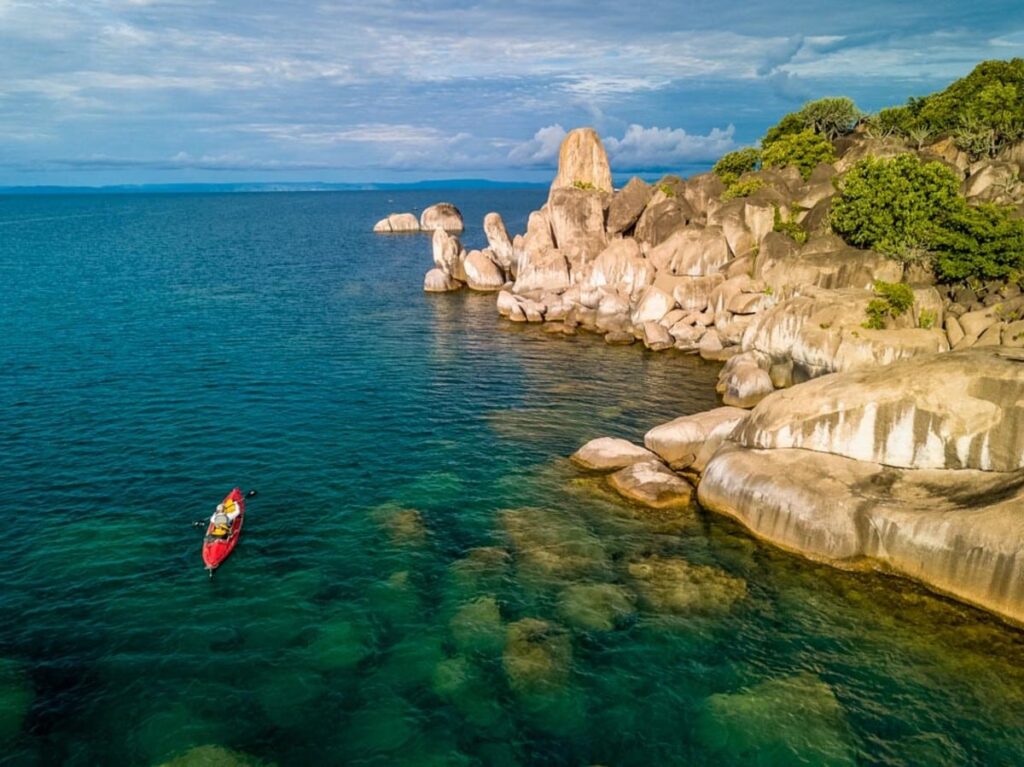
Lake Tanganyika is known for its remarkable water clarity, with visibility reaching up to 20 meters below the surface. The lake’s transparency allows visitors to clearly see massive underwater boulders, stunning drop-offs, and a lakebed covered with shells. This exceptional visibility makes it ideal for snorkeling, diving, and underwater exploration.
Lake Tanganyika has remarkably consistent water temperatures. The difference between the surface temperature and the deepest parts of the lake is only about 3°C. This unusual thermal stability is rare for such a deep body of water, and scientists still do not fully understand the mechanism behind it.
Endemic Fish and Aquatic Species.

The lake is especially noted for its cichlid fish species. These fish are important both for ecological studies and for the aquarium trade. Their evolution in isolation has been the subject of many scientific research projects.
Other Wildlife.
In addition to fish, the lake is home to mollusks, crabs, jellyfish, and other invertebrates. It also supports populations of Nile crocodiles, otters, and bird species that depend on the lake for feeding.
Fishing is a primary economic activity for many communities along the lake. The fish caught here are a major source of protein and income. The lake provides around 200,000 metric tons of fish per year.
Conclusion
Lake Tanganyika is a significant natural resource for Africa and the world. Its size, depth, and biodiversity make it valuable for both scientific research and local livelihoods. Continued efforts are needed to protect this ecosystem from growing environmental pressures.
